

|
|
Page 2 of 2
Near View Characteristics
A tree in the near view will have the following characteristics;
In this (near) view, the branches will appear to be very wide. Standing at the base of a tree, the branches reach a long way to the left and the right; an approximate foliage width (at the base) of 2/3 the height of tree's height is appropriate for an informal upright design.
As the branches are seen from the same perspective as the well-tapered trunk, the branches should also diminish noticeably in size the higher up the trunk they are. The first branches will be long and thick, the uppermost branches short and thin. This creates a foliage mass that is overall triangular. Create branches of similar thickness and length on a heavily tapered trunk and the perspectives are a mixed up and will not look satisfactory.
Seen from below in the near view, the foliage mass is dense and heavy. Little light is able to penetrate through the branches.
Deadwood features should be more heavily grained as they are seen closer up (in the near view) it should be possible to see that natural deadwood (jins and shari) are not just a smooth expanse of white wood.
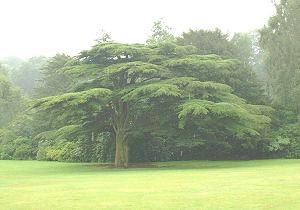
Cedrus libani at Tatton Park with light branching, less dense branching; negative space is evident.
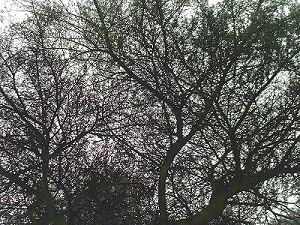
The same branches seen from below are very dense
Far View Characteristics
A tree in
the far view will have the following characteristics;
The branching appears a more natural width. Approximately 1/3
the overall height of the tree for an informal upright design.
From this far view, the branching is seen at a distance and is
more natural. The branches from base to top of the trunk have
less difference in thickness and are of more similar width; the
familiar scalene triangle is less pronounced or even absent. (Note
that the lower branches should still be longer and thicker than
those at the top, however, there should be less exaggeration than
when seen from the near view perspective).
The foliage canopy should be lighter. At a distance, the mass
of foliage should be broken up with negative space (areas without
foliage).
Deadwood features have less detail; if the viewer is to be made
to believe that the tree is a distance away, highly detailed jin
and shari should not be visible.
Bonsai in the far view should be planted in shallower but wider
pots that create an impression of a landscape.
Why is it necessary to establish the view at all?
Many of the
bonsai rules, or more properly, guidelines, are aimed at producing
an image of a tree as seen from below (in the near view). This
can dictate a trunk height to diameter of 6:1 or less, heavy lower
branching and lighter branching in the apex and a foliage mass
that forms a triangular shape.
But, in trying to create a more natural, realistic bonsai, one
can also take a more natural view of a tree. That is, as seen
from a distance where the rules of perspective have less influence
on the overall design.
The majority of trees, both young and old, do not have massively
tapered trunks; in fact the majority of old trees we see in our
day-to-day lives have trunks with quite slow taper.
However,
to portray a natural tree seen from a distance, one also has to
reflect the natural characteristics of a tree seen from a distance.
Using near view characteristics on a slow tapering tree will very
often just produce a bonsai that simply looks very young and immature
instead of an image of an old tree seen on the horizon.
Finally.....
In writing this article I have given two extremes by way of explanation; a tree that is seen from its base and a tree that is seen in the distance. There is no reason why a tree has to be strictly one or the other; there are a range of views in between. The range and subtlety of these characteristics should therefore differ accordingly.
The trunk height to trunk diameter ratio of 6:1 that is often spoken of, is a guideline. Material that has pronounced trunk taper but has a ratio greater than 6:1 is still suitable for bonsai, just not in the near view.
Whether it is the slow, subtle taper of a tree seen faraway or the heavy, abrupt taper of a tree seen close-up, all bonsai should have trunks with a degree of taper. A bonsai without taper will always look like a young tree!